
About Beekeeping
Beekeeping is an exciting hobby that the whole family can share. The life of the bees and their division of labor is one of nature’s great wonders, incredibly interesting and educational.
If you wish to become a member of Honningcentralen, send an email to post@honningcentralen.no
BEEKEEPING FOR BEGINNERS
The number of beekeepers in Norway has increased significantly in recent years. Especially hobby beekeepers have become many more. Perhaps the attention to climate change is part of the reason. There is also increasing interest in organic food, growing your own vegetables and keeping hens in the garden, so there is reason to assume that these are coinciding trends. In any case, to start beekeeping you need both knowledge and equipment.
A HOBBY WITH RETURNS
Most hobbies cost money – that also applies to beekeeping. We recommend beginners to start with 2–6 hives. Being a commercial beekeeper can be a good livelihood, but many also practice beekeeping as a hobby first and foremost because life in the hive is fascinating and exciting to follow and develop. There are also some who work with beekeeping because they want to ensure pollination of, for example, fruit trees and berry bushes.
NOT SO TIME-CONSUMING
When you have passed the first period as a beginner, you can expect to spend 1–2 hours per week. There is most to do from April to September, when the bees must be tended every fifth to seventh day. During the winter half of the year there is significantly less work.
ANYWHERE
You do not need to have your own smallholding in the countryside to practice beekeeping. Many keep bees in the city as well. A garden patch or a flat roof is sufficient for a couple of hives. A good alternative is to borrow a place for the bees. Landowners, especially those who grow fruit and berries, are often positive about getting more bees to help with pollination. That increases their yields.
Enthusiastic beekeepers often move their hives in late summer. At that time there is abundant nectar in the heather. It blooms on the heather moors found in most parts of Norway south of Finnmark. From the heather we get what is called heather honey, the most common honey in this country.
START WITH A COURSE
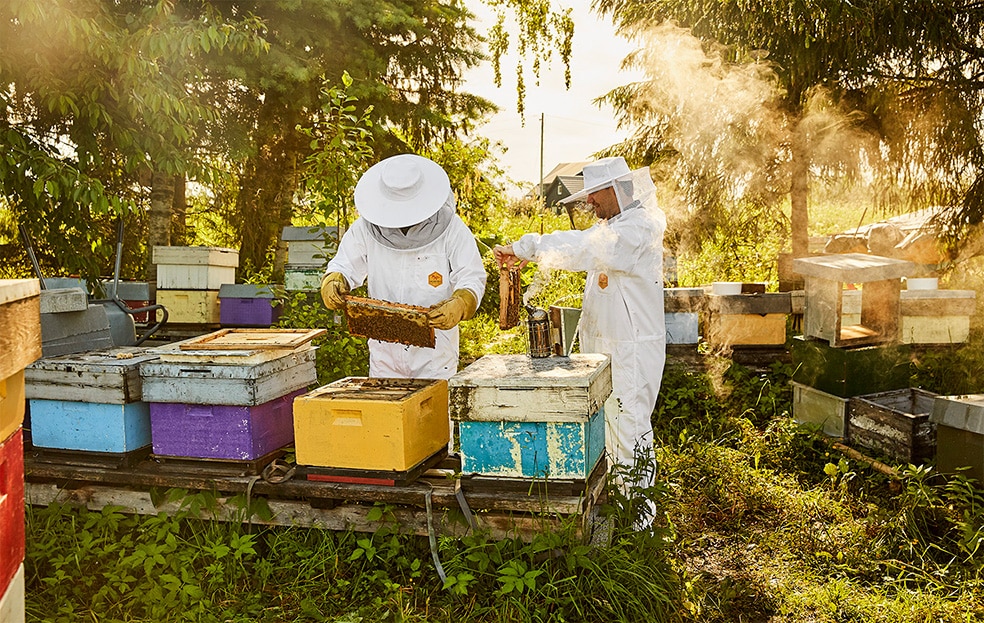
Bees are livestock. They are living beings and must be treated with respect and knowledge, just like other animals. If you do that, you are rewarded with insight into a fascinating world and plenty of delicious honey. One beehive usually yields as much as 25 kg of honey per year.
The Norwegian Beekeepers Association has local branches throughout the country. They regularly arrange courses for beginners. You will learn what equipment you need and how to tend and take care of your bee colony.
EQUIPMENT YOU NEED
All the equipment you need can be purchased in our online store, and if you become a member of Honningcentralen you receive a member discount on your purchase. Bees are purchased from local beekeepers in your area. Attend a course and you will find out who sells in your area. Take a look at our online store: https://nettbutikk.honning.no/
WHAT DO YOU NEED? ?
- A complete beehive with frames and wax
- Bee colony (purchased from a local beekeeper)
- Beekeeping clothing (suit, hat with veil, gloves)
- Tools (smoker, brush, hive tool)
- Honey extractor (at the beginning you can borrow one)
KSL
Quality-conscious consumers must be able to trust that Norwegian-produced food is of high quality and is produced in a way that takes into account animals, people and nature in general. Therefore, the agricultural industry has developed its own quality system, Quality System in Agriculture (KSL).
KSL ensures quality and safety for farmers, industry and consumers.
If KSL is followed, operations comply with laws, regulations and requirements from raw material buyers.
KSL is the industry’s joint quality system for primary production and is recognized by the Norwegian Food Safety Authority as a national industry standard.
KSL develops operations on the farm.
KSL is a requirement for the NYT NORGE label.
KSL builds the reputation of Norwegian food production:
- Free from infection and without harmful foreign substances
- In line with consumers’ wishes regarding appearance and taste
- Produced with good animal welfare
- Produced in an environmentally friendly way
- Produced in a safe working environment that ensures good health for practitioners
Read more about KSL (Norwegian only)