

How is honey made?
Honey is a pure natural product that contains several sugars, a number of vitamins, minerals, enzymes, antioxidants and water. Honey is sweeter than sugar, so you can use less sweetener if you replace sugar with honey.
It is also documented that honey has a beneficial effect on sore throat.
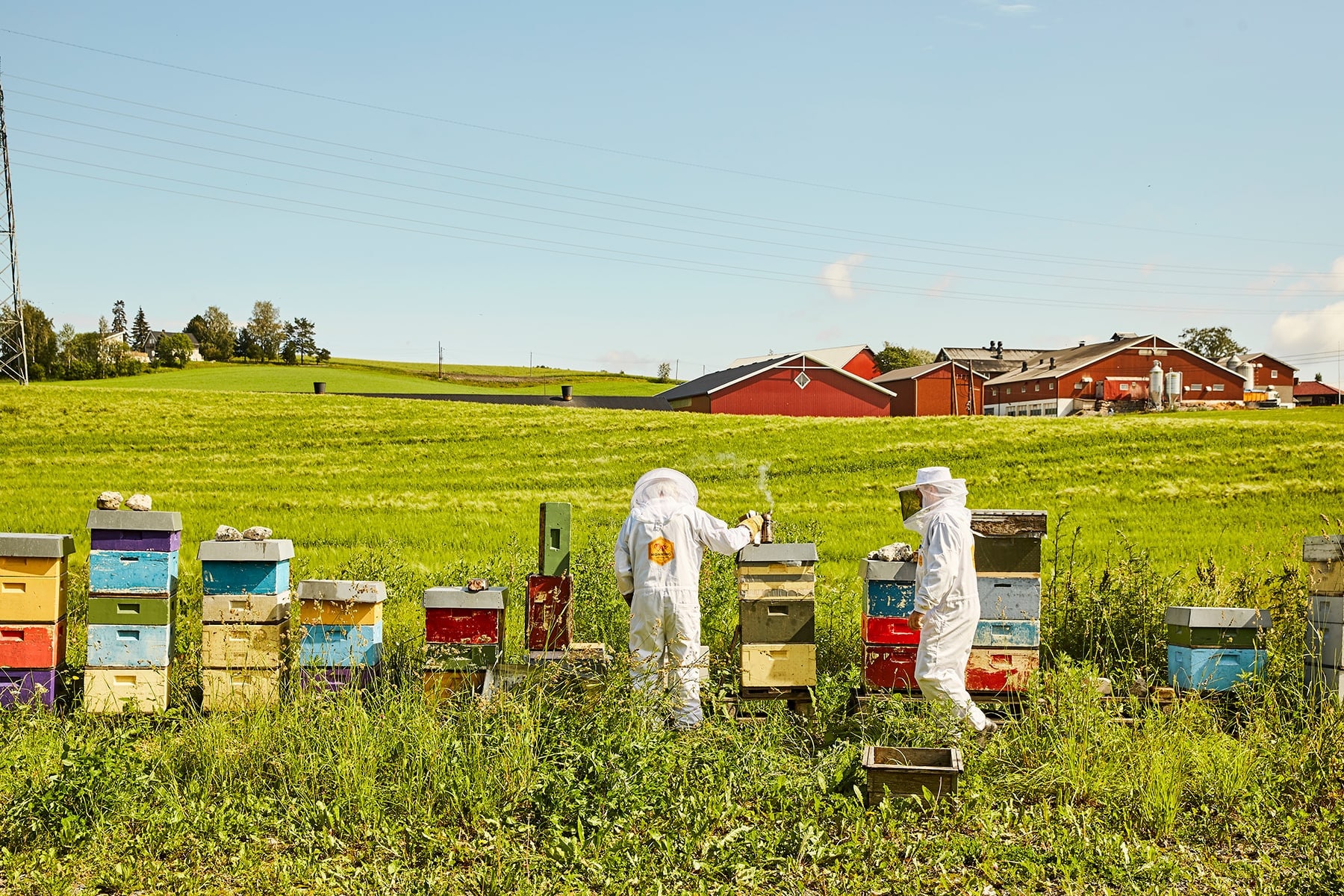
How is honey made?
Bees collect nectar from flowers. They mix the nectar with an enzyme in their bodies and place it in wax combs in the hive. The bees then dry out the water in the nectar by beating their wings, and the honey is finished. The honey is food that the bees store for themselves and the larvae. (They produce much more honey than they are able to eat themselves.) The beekeeper removes the combs and places them in an extractor (a kind of centrifuge). The extractor spins at high speed and empties the combs of honey. Some call honey treated in this way cold-extracted, but it takes place at fairly normal room temperature. Almost all honey is treated in this way.
In addition to nectar, the bees collect pollen. Some of the pollen is used as food by the bees, but most importantly the bees carry pollen to other flowers, which are then fertilized (pollinated). 30% of the food we eat depends on pollination from bees.
Bees must visit more than 20 million flowers – or make over 60,000 flights – to produce 1 kg of honey. A bee produces less than a teaspoon of honey during its entire lifetime.
Liquid and solid (crystalline) honey
The ratio between the main sugars in honey (glucose and fructose) determines whether the honey becomes liquid or solid (crystalline). All honey is liquid when it comes from the hive. If the honey contains more glucose than fructose, the glucose will encapsulate the fructose and form crystals (crystallize). Eventually the crystals cause the honey to become completely solid. The most common is that honey is crystalline. To prevent crystals from forming, the honey is stirred. This breaks the crystals, and the honey gets the creamy consistency that we know from regular Norwegian honey on store shelves. If you buy honey that later crystallizes, you can place it in a lukewarm water bath. The crystals will dissolve after a while.
What is acacia honey?
The most well-known exception to crystalline honey is acacia honey. It comes from the tree Black Locust and contains more fructose than glucose. Then the glucose is not able to encapsulate the fructose, and the honey remains liquid. Among Norwegian honeys, honey from blueberry, lingonberry and Mikkelsbær in particular has the same property. Heather honey also remains liquid for quite a long time and often becomes jelly-like over time.